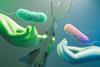
New modelling suggests that even if we could create cells based on mirror-image biomolecules, their natural counterparts would outcompete them in the wild

Mirror life

Source: © Thom Leach/Science Photo Library/Getty Images

Bacteria created with mirror-image biomolecules would face different survivial pressures to their natural counterparts

At the end of 2024, a new technological doomsday scenario arrived to haunt us. Besides worrying about the possibility of artificial general intelligence that deems humans no longer necessary, or a lab-created virus that wipes us out, a group of researchers warned in Science that ‘mirror life’ – lifeforms in which the chiral biomolecules are mirror images of our own – could, if created, ravage the biosphere.1 

There are echoes here of the ‘grey goo’ scenario evoked in the 1990s for nanotechnology. The fear was that nanotechnological robots that can assemble copies of themselves by pulling matter apart atom by atom could run rogue and disassemble the whole planet. Such a nightmare was predicated on a technology that no one was trying to make (or even knew how to).

 But mirror life is different. There has already been remarkable progress towards making DNA, proteins and even the components of the protein-making ribosome in mirror-image forms, for example using amino acids of opposite chirality to those in nature. Whether these can be assembled into synthetic cells – genuine mirror life – is another matter, but some of the researchers issuing the safety warning compiled a document arguing that it is far from implausible and might even become possible, given the necessary research investment, in not much more than a decade.2 

How worried should we be? The researchers said that ‘Unless compelling evidence emerges that mirror life would not pose extraordinary dangers, we believe that mirror bacteria and other mirror organisms, even those with engineered biocontainment measures, should not be created.’ But a recent preprint by complexity theorist Ricard Solé of the Universitat Pompeu Fabra in Barcelona and colleagues argues that there are strong ecological constraints that would make ‘the widespread establishment of mirror organisms in the extant biosphere highly unlikely’.3 In other words, there’s no need to panic: mirror life wouldn’t get far in the wild. 

Reflections on making mirror life

The homochirality of life – proteins use only ‘left-handed’ amino acids and DNA incorporates right-handed sugars – is one of its enduring mysteries. There seems no reason to suppose that life could not have equally thrived with the opposite handedness. Some researchers have interpreted that as a challenge: can mirror life be created? 

Making mirror-image biomolecules is not a frivolous affair.4 Drugs based on mirror proteins could be capable of binding therapeutic targets while being invisible to the protease enzymes that break proteins down in the body. Mirror proteins might also avoid triggering the inflammatory immune response that some foreign proteins incur. It’s the same story for drugs based on mirror nucleic acids, which are ignored by nuclease enzymes. At least two companies, TME and Aptarion in Germany, have been trying to develop them. 

Mirror proteins can be assembled residue by residue, but how much easier it would be if we had a mirror ribosome that could make them to order. That’s what chemist Ting Zhu of Westlake University in Hangzhou, China, has been trying to make for several years, and so far he has made mirror versions of the three key ribosomal proteins.5 Zhu and colleagues have also made mirror polymerases that can create and amplify left-handed DNA.6 

Can these parts be put together in a mirror cell? When I asked Zhu’s mentor, Nobel laureate Jack Szostak, that three years ago, he told me that ‘Making a mirror-image cell with a complete mirror-image protein synthesis system is a hugely ambitious goal, but I think it’s worth trying, just to see what the hardest problems are.’ Now Szostak has become more concerned about the dangers, and he is a coauthor of the cautionary Science paper. (Zhu told me he’s happy to leave attempts at making mirror life to others.) 

All seem agreed of the need to steer a course between complacency and alarmism

That paper warned that mirror bacteria would, by virtue of their ‘orthogonality’ to normal biochemistry, evade natural checks on their spread, such as predation and attack by phage. The chirality of nutrients would not be a limiting problem in the wild, as many bacteria are already known to thrive on achiral nutrients. But Solé and colleagues present quantitative modelling showing that the competition between natural and mirror life will favour the former.3 

Mirror life will be at a disadvantage since resources of the chirality needed by normal life dominate in the ecosystem. And even in a system with predation, mirror life is unlikely to be capable of successfully invading unless the natural counterparts are somehow suppressed. ‘The biosphere acts as an active ecological and biochemical filter that strongly limits the persistence of organisms outside its norms’, the Barcelona team says. 

It’s not the last word, and indeed Szostak has suggested that the parameters of the model could be more permissive of successful invasion than the authors imply. All seem agreed of the need to steer a course between complacency and alarmism. And perhaps to remember that, as of yet, we’re not even close to making normal life from scratch.