
After independently uncovering new synthetic pathways for generating substituted alkenes, two researchers were introduced by a journal editor who spotted similarities between papers they had rejected
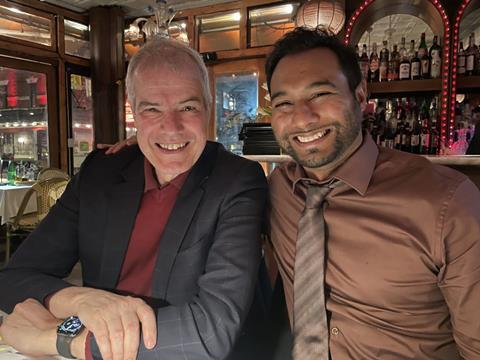
Learning another laboratory has made a similar breakthrough as your own can feel unsettling or even intimidating. So, when research groups in the US and Germany realised they had independently developed photochemical methods for converting nitroalkanes into highly substituted alkenes, rivalry might have seemed inevitable. Instead, the discovery from teams working miles apart sparked a friendship and a collaboration.
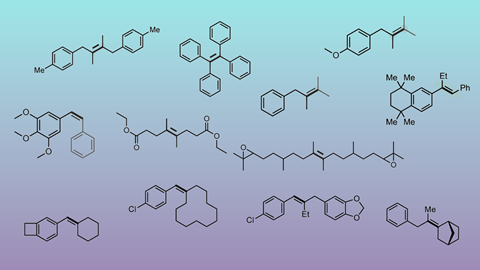
Olefination reactions are well-established yet many of the classic methods – including McMurry coupling, Julia olefination and Wittig reactions – require harsh conditions that limit functional groups tolerance. McMurry coupling is particularly useful for generating tri-substituted alkenes, but researchers are still working to improve its stereoselectivity. As alkenes play a vital role in drug development and materials science, accessing as broad a range of alkenes as possible is a longstanding goal.
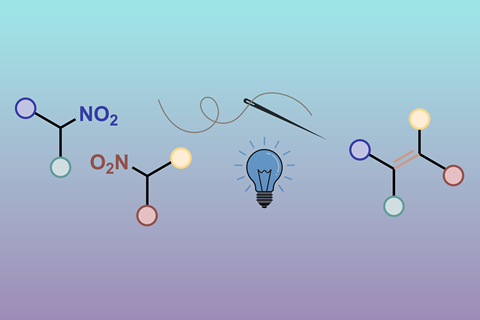
Now, two research groups have separately harnessed visible light to produce di-, tri- and tetra- substituted alkenes from readily accessible nitroalkanes-based substrates, including carbonyl- and heterocycle-containing compounds. Together, the methods establish unactivated nitroalkanes as a general building block for creating alkenes via a process that Marvin Parasram, of New York University, describes as ‘photostitching’.
Parasram’s team had originally been investigating how visible light can promote heteroatom transfer through nitroarenes, nitroalkanes and nitronates. But when then-PhD student Joshua Mitchell was extending the concept to create carbenes, he instead made alkenes. Once they achieved high cross-selectivity, ‘we were off to the races’, Parasram explains adding: ‘It’s not an obvious retrosynthetic disconnection. Nitroalkanes to form a double bond, it’s not the first thing people think of right? That brings some excitement and the fact you can functionalise the starting materials very easily adds to its value.’
Proceeding via an α-nitroalkyl radical intermediate, the nitronate itself absorbs light and acts as a powerful photoreductant. The team observed that the stability of the radical intermediate influences the stereoselectivity of the products. This reaction primarily produces tri-substituted alkenes and some tetra- substituted alkenes,1 but Mitchell explains the approach taken by Oliver Reiser’s team at the University of Regensburg2 could prompt them to revisit starting materials they once dismissed.
A radical transformation
An unexpected finding was also behind Reiser’s team’s new olefination strategy. While studying the reactivity of the single-electron α-nitroalkyl radicals as part of copper photocatalysed addition and cycloaddition reactions, new PhD student Max Dietel noticed a ‘weird peak’ in his NMR spectrum. Rather than dismissing it as an unwanted side product, Reiser advised him to investigate further. It proved to be the first in a suite of alkenes the team would go on to make.
Reiser describes ‘stumbling over’ this alkene product as an example of what Nobel-prize winner David MacMillan calls ‘accelerated serendipity’. Simply exploring how moving to a different catalyst – photoredox Ru(bpy)₃²⁺ – brought ‘out of nothing, an unexpected result in alkenes’.
Using this ruthenium photocatalyst, Reiser’s team has now developed coupling reactions that covert simple nitroalkanes into di-, tri- and tetrasubstituted alkenes with high stereoselectivity. The photocatalyst oxidises the nitronate to generate an α-nitroalkyl radical that initiates homo- and cross-coupling reactions. Dietel says that as methods like theirs and the Parasram group’s improve, the scope to access more alkenes is huge. Likewise, Mitchell says there’s so much ‘untapped potential’ in developing nitroalkanes as a platform for olefination.
From rejection to collaboration
The two groups only connected after a Science editor who rejected papers from them both noticed the similarities and put them in touch. Both groups were excited to discover that the reactivity they were exploring ‘had greater potential than we thought initially’, explains Reiser. For Parasram, the works are ‘truly complementary – one is not better than the other’ and connecting with Reiser was one of the best outcomes.
A fan of Reiser’s work since grad school, Parasram was surprised their paths had never crossed before: ‘It’s crazy because a couple of weeks after, Oliver was in New York. We met for dinner and coordinated our next submission to JACS.’
‘It was nice to have someone to discuss the chemistry with, but we didn’t see each other’s papers until we posted on the archive,’ says Parasram. ‘We’re good friends now and I’ll have him here as a seminar speaker soon.’
‘Instead of being disappointed that we got scooped, we were able to appreciate each other’s work,’ adds Reiser.
Now collaborating, the teams are fine-tuning the reactions and collating the scope of alkenes accessible under each set of reaction conditions. Unlike the Parasram team, Reiser’s group primarily produced tetrasubstituted alkenes, including a protected precursor of combretastatin-A4, an anti-tumour drug. He says he was ‘struck’ by the Parasram team’s work not needing a catalyst but after running to his co-workers to triple-check, was reassured their products couldn’t be made without the catalyst. Meanwhile, Dietel says he’s keen to observe the radical intermediates throughout the reaction with time-dependent electron paramagnetic resonance.
Although both groups independently proposed light-driven, radical-mediated mechanisms, understanding the finer details of the reactions remains a challenge. So too does teasing out the best conditions for specific alkenes and improving selectivity. ‘[It] turns out these nitro radicals are very versatile and we’re both now exploring this more,’ says Reiser. ‘That’s what’s fun about this – we can enhance the chemistry which will hopefully be beneficial to the wider research community,’ adds Parasram.
Both Parasram and Reiser hope their story will inspire others to collaborate rather than compete. Together they have already generated new ideas, and they are now planning student exchanges.
References
These articles are open access
1 J K Mitchell et al,J. Am. Chem. Soc., 2026, 148, 31690 (DOI: 10.1021/jacs.6c06460)
2 M Dietel et al,J. Am. Chem. Soc., 2026, 148, 31680 (DOI: 10.1021/jacs.6c06459)







No comments yet