Photochemistry, biocatalysis, electrochemistry and organocatalysis combine in an enjoyable polyketide synthesis
Despite their seemingly endless variety, most natural products – or, more precisely, secondary metabolites – can be classified as either terpenoids, alkaloids or polyketides, according to the biosynthetic pathways that birth them. With a little practice, you can usually tell at a glance which class a molecule belongs to. And, when you’ve read enough papers, you’ll also notice that the total syntheses of these classes each possess their own unique character.
In the 15 years I’ve been writing this column, we’ve mostly discussed terpenoids and alkaloids. You might assume this is a statistical artifact of these being arguably the two largest families of secondary metabolites, with around 40,000 and 20,000 known compounds respectively.
In truth, however, it’s just because I’m biased. I love the intricate, fused ring systems of terpenoids, with their carbon chains twisted and rearranged into ever more tortuous shapes, demanding the development of new methodologies. And alkaloids present an entirely different puzzle, with their tricky nitrogen atoms and stereodense heterocycles. They also have a romantic appeal due to their historical significance, as so many of the classic targets that drove the field forward last century fall into this class.
Then there are polyketides. Undoubtedly, the pursuit of these targets greatly advanced the field of asymmetric synthesis in the 1980s and 1990s, but these days it feels like the synthetic community has moved on. The chemistry can often feel repetitive, and while the targets are unquestionably complex, their predictable, often linear backbones can start to look quite similar, leaving me underwhelmed when a synthesis is completed. This is a shame, as this class has given us lifesaving antibiotics, immunosuppressants and anti-cancer drugs, and humanity could no doubt benefit from further studying these molecules.
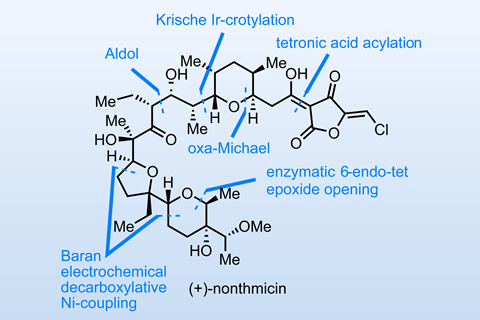
I was surprised, then, how much I enjoyed the recent synthesis of nonthmicin reported by Chao Li and coworkers.1 The team’s route to this intriguing antibacterial natural product expertly employs photochemistry, biocatalysis, electrochemistry and organocatalysis. In other words, it’s a thoroughly modern approach.
Let’s start with the southern half of the molecule (figure 1). A Baran-type electrochemical decarboxylative cross-coupling is used to assemble the carbon skeleton, and this is followed by a classic Sharpless asymmetric dihydroxylation of the new trisubstituted olefin. Here, the team hits its first snag. The original plan was to form the desired tetrahydropyran ring by using the newly installed secondary alcohol to open the nearby epoxide. However, closing the six-membered ring requires a 6-endo-tet cyclisation, which is disfavoured by Baldwin’s rules, and despite some encouraging literature precedent, the team could only isolate the unwanted 5-exo product. Fortunately, using an epoxide hydrolase enzyme – which literature consensus suggested shouldn’t work here – the team is ultimately able to secure the desired product in excellent yield.

A little further down the road, a Henbest-type directed epoxidation and subsequent ring-opening form the molecule’s lone tetrahydrofuran (figure 2). Then the route’s only aldol reaction is used to unite the two halves of the molecule. Despite the apparent simplicity of the conditions, it took extensive optimisation to execute this on the unprotected ketone fragment, but the team is rewarded with high diastereoselectivity and a good yield (up to 80% based on recovered starting material).
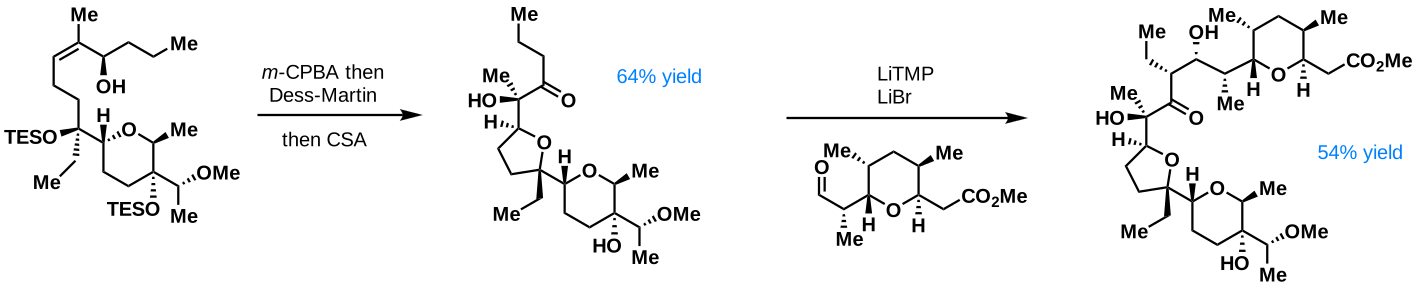
From here, just a couple more steps complete an efficient first total synthesis of the target. Even more impressively, the team prepared over a gram of the natural product via this route, allowing them to profile its biological activity.
References
1 L Tao, C Li et al, J. Am. Chem. Soc., 2026, 148, 41593 (DOI: 10.1021/jacs.6c15393)






No comments yet