



This week, we look back at how far click chemistry has come in the last 25 years and discuss the strange bonding behaviour of some of the largest elements on the periodic table with Mason Wakley and Frances Briggs.
This week’s headlines
Featured stories
Last month marked 25 years of click chemistry. It started as a review paper in 2001 that has since been cited almost 20,000 times, becoming one of the most influential chemistry papers ever written. The discipline has spread across a wide range of fields, from medicine to materials, opening up molecular design to scientists who don’t necessarily have a deep background in complex synthesis. But what may the next 25 years hold for this field?
Scientists have spent decades grappling with a deceptively simple question: how do the actinides – some of the heaviest elements in the periodic table – actually form chemical bonds? Studying these elements is far from straightforward; their intense radioactivity and the complex behaviour of their 5f electrons make them notoriously difficult to probe. While previous experiments have offered glimpses, these have yielded mostly indirect or incomplete answers. Now, thanks to the development of advanced analytical techniques, chemists may finally be getting a clearer picture of how these elements bond.
We would love to hear your feedback on this new podcast, so if you have any questions or comments please get in touch.
Introduction and headlines
Mariana Kneppers
Last month, click chemistry turned 25 years old, providing a new way to build molecules. But what defines A click reaction, and what does the future hold for this field? And new research has revealed experimental evidence of how covalent bonding affects the 5F orbital in early actinides. We discussed the challenges of studying these elements.
I’m Mariana Kneppers, Chemistry World science media producer, and this is the Chemical Breakdown. We’ll be diving deeper into these stories shortly, but first let’s take a look at this week’s news from the Chemistry World website.
High temperatures have been shown to disrupt the function of cellular structures that deliver oxygen to corals. The finding reveals a new stress mechanism linking warming seas to coral death that could help inform decision-makers on where to focus conservation efforts.
During his time as U.S. Health Secretary, Robert F. Kennedy Jr. has sent shockwaves through vaccine research, cancelling funding for mRNA research and reshaping scientific priorities. Experts warn that his policies could have lasting consequences for innovation and the nation’s preparedness for future pandemics.
Chemistry departments in the UK have not yet been impacted by global helium supply shortages caused by the ongoing Gulf conflict. Many attribute this to a helium recovery system, which allows departments to continue to run various analytical equipment in a business-as-usual scenario.
Sanctions and international isolation caused by the ongoing war in Ukraine have disrupted Russia’s chemistry sector, cutting off collaboration and access to materials. However, the crisis is also driving growth in key industries like fertilisers and renewed interest among a new generation of chemists.
You can find these stories and more online. Just visit chemistryworld.com for more of the latest news in the chemical sciences.
Click chemistry: background and significance
Mariana Kneppers
Last month marked 25 years of click chemistry. The main idea is in the name. Like the satisfying click of a buckle when fastened or of two Lego bricks snapping together, click chemistry is a way of building molecules using simple, highly selective chemical reactions that work under mild conditions.
It started as a review paper in 2001 that has since been cited almost 20,000 times, becoming one of the most influential chemistry papers ever written. The discipline has spread across a wide range of fields, from medicine to materials, opening up molecular design to scientists who don’t necessarily have a deep background in complex synthesis.
Click chemistry has certainly come a long way in the last quarter decade, but what does the next 25 years hold for this field? Here to discuss today’s stories are science correspondent Mason Wakeley and Chemistry World intern Francis Briggs. Hello to you both.
Mason Wakley
Hello.
Frances Briggs
Great.
Mariana Kneppers
Thanks so much for being here, both of you. Mason, let’s start with you. Can you give us a background? What exactly is click chemistry? It sounds like there are some quite specific defining features.
Mason Wakley
Yeah, sure. So you mentioned it earlier. It’s this idea of taking two molecules and really efficiently and simply joining them together. But they need to be quite wide in scope. They need to be applied to lots of different types of substrates. It can just kind of happen with a very specific set of molecules.
They’re often quite high yielding. You don’t necessarily need to purify them that extensively after they’ve clicked together. And they’re often driven by thermodynamics. So I think they need to be around sort of 20 kilocals per mole for this reaction.
Those original scientists, which included Barry Sharpless, MG Finn and Cole Hartmuth, win their review paper. That was one of the conditions that they said. So yeah, you’re right, there’s quite a few different conditions that you need for it to be defined as a click reaction.
Mariana Kneppers
I see. And why are there such specific conditions? Is that just because those are the specific set of conditions that make these kind of simple reactions reliable?
Mason Wakley
I guess there are potentially quite a lot of reactions that could be seen to be a click reaction, i.e. a lot of reactions are joining 2 molecules together to some degree, but to kind of fall under this umbrella term, you would need to meet all of these conditions. Otherwise, it would be hard to kind of distinguish between what is a click and what isn’t.
Applications and advantages of click chemistry
Mariana Kneppers
That’s a really good point you make. There are lots of chemical reactions out there that are taking two products and combining them together. The specific set of conditions is what kind of defines click chemistry. And so why is it so revolutionary? I mean, is it the kind of simplicity of it? they describe it as things like clicking together 2 Lego bricks. it feels like quite a manual form of assembly, if that makes sense.
Mason Wakley
Yeah, no, I think that’s true. I think one of the reasons why it was so revolutionary is what you said is because it’s so simple. It really helps to democratise the field of science because people that don’t necessarily have a deep organic chemistry background are able to do these types of reactions, which has opened up a whole bunch of fields.
So this might be using them to tag biological molecules with radio labels or to form cross-linked polymers. or to kind of study what’s going on in biological systems. And you can then rely on these reactions happening. So that when they do happen, they’re going to happen pretty much 100% of the time.
I think it’s worth mentioning that one of the key types of click reactions are these sort of copper assisted click reactions where you’re combining an alkyne with an azide to form a triazole ring. So that’s a very stable ring that isn’t then necessarily going to fall apart that easily.
And That has now become such a routine type of click chemistry that is basically quite easy. The main purification method is the removing the copper salt at the end once you no longer need it, which is really important in biological context because you don’t want your copper contaminating your cells or bacteria or such.
Mariana Kneppers
Is it like the copper provides A framework for you to attach things onto and then at the end you can kind of just pop off the copper?
Mason Wakley
Yeah, as far as I’m aware it’s sort of an ion that can then help sort of coordinate the alkyne and the azides together to be in the right space in the right geometry that you want so that it can undergo the cycloaddition to form the triazole ring.
And then once you’ve done that you don’t actually need the copper. It’s sort of there as sort of as a catalyst, but it’s not necessarily speeding up a reaction. It’s all there just to aid the reaction.
Mariana Kneppers
I see. That makes sense. So, you know, this is a kind of synthesis. Is that fair to say?
Mason Wakley
Yeah, definitely.
Mariana Kneppers
How would this compare to like more traditional chemical synthesis then? I think we’ve talked about it in the past on the podcast. People who are synthetic chemists go through quite an advanced level of training because it is quite a specific discipline, isn’t it? So how would you compare this kind of synthesis to the more traditional synthesis?
Mason Wakley
I think a great thing is that often these click reactions are one step. So you’re not having to do your multi-step synthesis to get the molecule that you want. Often these are involved in sort of late stage modifications that then you can join 2 molecules right when you need them at the end.
And if you’re thinking about how to connect A with B, you don’t necessarily then have to build a complicated scaffold and undergo lots of different reactions to join them together. If you tag one with say an azide and one with an alkyne right at the end, once you’ve done all your fabrication to these two components, you can then join them together and kind of get the final molecule that you want.
So yeah, I would say it’s definitely a lot simpler in terms of how we think about organic synthesis.
Frances Briggs
Is it fair to also say that it could be quicker, I guess, because you don’t have to do all of those small steps that you would have to do in total synthesis.
Mason Wakley
Yeah, I would imagine so. I’ve not necessarily done any click reactions myself from my time in the lab, but yeah, I would definitely imagine it would be. And I think a big part of that is not necessarily having to purify at the end.
And because they’re quite reliable, you haven’t necessarily got that much, presumably unreacted starting materials, they’re kind of quite efficient. So that A&B have clicked together, you’ve probably likely just got one final product.
Biological uses and future of click chemistry
Mariana Kneppers
Yeah, fair enough. So it’s a different kind of synthesis. It’s more accessible to maybe people who don’t have a pure synthesis background. So what kind of scientists are using click reactions? Like how are these actually applied?
Mason Wakley
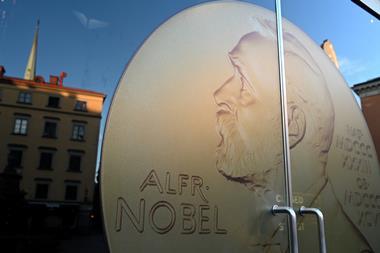
I think a really good example of that has been from Carolyn Bertozzi’s work, who, along with Barry Sharpless and Morton Mendel, won the 2022 Nobel prize. And her contribution was this idea of bioorthogonal chemistry, which is the idea of being able to do these click reactions in living systems without affecting or being affected by the whole kind of complex chemistry that’s happening within the cell itself.
And this allows chemists and biologists and other scientists to understand what’s going on with certain biological processes, what’s actually happening in the cell in real time rather than kind of inferring what’s happening from other experiments.
So I think a big part of her work was using a type of a click reaction called Staudinger ligation which uses an azide and a phosphine to form a stable amide bond which then are not necessarily that easy to break down within a biological system and use that to study the proteins and the sugars on the surface of cell membranes, which was previously quite difficult to do.
But outside of that, people have found whole different uses for these types of click reactions and are continuing to find new ones that fit the definition. So yeah, it’s a really exciting time, I think.
Frances Briggs
I’m curious how with Carolyn Bertozzi like looking at living organisms How did she get around, do you know, the copper toxicity element?
Mason Wakley
I’m not entirely sure whether her reactions actually use copper or not. I think because it’s a slightly different, like two different reagents coming together, I think that…
Frances Briggs
She kind of just kept…
Mason Wakley
I don’t know if she needed the copper for the reaction. I’m unsure about that. But I mean, copper is an essential element for most living organisms. I guess it’s just the amount that might be being used that could be the toxic issue.
So maybe she was able to get away if she was using copper to use less. But again, not 100% sure on that.
Mariana Kneppers
That’s interesting. I do remember looking in the article that you wrote for this, Mason. It’s quite interesting, the idea of conducting these experiments within a biological system. Our bodies are designed to break things down into their components.
So to find something that kind of can withstand that and still carry out the function that it needs to, that must have really big implications in drug design.
Mason Wakley
Definitely, and I think these click reactions are being used in these click to release drugs. That’s kind of a big area that’s coming out now, which is the idea of joining a drug to, say, an antibody or a targeting vector to deliver the drug to a specific cell or a specific target, and then almost doing a reverse click reaction, if you will, to then release the drug at the site that you want.
So some click reactions have, I guess, some degree of reversibility. And they’re also useful in antibody drug conjugates.
So combining an antibody with a drug, very similar to a click to release drug system, but you can then combine quite a large antibody that’s quite hydrophobic to a drug and then you’ve got both systems that you need.
So yeah, definitely very useful in biological context or even saying, okay, well we know this part of a drug molecule is really useful and we know that this one has some good properties too, maybe it’s hydrophobic, maybe it’s got a certain geometry or certain shape. how can we combine these two together?
It’s now relatively simple. If you want to modify those drugs with these groups that you would need to do a certain click reaction, you join them together relatively simply and then now you’ve got a new drug that might have superior properties.
Mariana Kneppers
That’s amazing. It’s so cool how you can design like the kind of minutia of these chemical interactions. The idea of that, what was it that you said the reversible click reactions? That’s quite cool.
It just reminds me of almost like having like a little little robotic hand inside the body that just goes, boop, move this here and undo it here. I don’t know, that’s probably not the best way of describing it, but that’s how I imagine it.
Obviously, click chemistry has accomplished so much in the past 25 years. The big question is, what does the future hold? Are there any exciting kind of future applications that you see on the horizon?
Mason Wakley
I know that Sharpless and his team have been working on new, different types of click reactions. So this is looking at things One of them is a suffix reaction where you’re taking sulphur containing molecules that have a sulphur fluorine bond and then being able to combine that with certain molecules that have like alcohols or amines.
And they’ve even done some work with similar systems instead of sulphur but with phosphorus. So they look quite simple reactions on paper, but they’ve not necessarily been explored before and are able to join them together in the same way.
But when I was speaking to MG Finn, who was involved with that original review paper, he said that he’s looking at trying to use these click reactions to help him understand how biology may have evolved.
The idea that biology has evolved really simple, really efficient ways of clicking amino acids together, for example, to form proteins. And if we can maybe look at similar systems to kind of organic non-biological click reactions, can we see how that has gone from that to a self-replicating way of clicking molecules together?
So kind of this concept, which kind of I think leads back to how that original click idea came back together, if that was their inspiration of looking at how does biology do this and are there any examples that we can find?
So yeah, I think there’s a whole breadth and he thinks that aside from biology, like the use of click chemistry and material science, for example, been vastly underexplored and is still quite an emerging field.
So yeah, I think there’ll be lots of applications over the next 25 years. And even though it’s been such a revolutionary idea, there was a study a couple of years ago of someone trying to do the copper assisted reaction. It’s often done in water and now doing it without any solvent at all.
And so I think there will also be a level of refinement of these ideas. So even though they’re great, how can we make them better?
Mariana Kneppers
Yeah, exactly. There’s always room to grow and kind of improve on these. Definitely a field to keep our eyes on, for sure.
Actinides and 5F orbital research
Mariana Kneppers
For decades, scientists have grappled with a deceptively simple question. How do the actinides, some of the heaviest elements in the periodic table, actually form chemical bonds?
Studying these elements is far from straightforward. Their intense radioactivity and the complex behaviour of their 5F electrons make them notoriously difficult to probe. Previous experiments have offered glimpses, but mostly indirect or incomplete answers.
Now, thanks to the development of advanced analytical techniques, chemists may finally be getting a clear picture of how these elements bond. So, Francis, what exactly are the actinides, for those of us who don’t know them?
Frances Briggs
So the actinides are a series of heavy elements in the periodic table. They start, as the name suggests, at actinium and go on to lawrencium.
But often the actinides like uranium, plutonium, they’re used in nuclear power. And I think that is part of what makes actinides so interesting, their radioactivity.
But I think hand in hand with that, I would say that actinides are very interesting because we don’t really know that much about them relative to the lanthanides, the series before them, which lanthanides have a much more simple trend across the series.
Whereas when it comes to actinides, they behave in ways that you wouldn’t necessarily expect. The bonding they have doesn’t follow the same pattern as lanthanides necessarily.
So for the chemists who are looking into these elements, we really just want to explain their unpredictability and understand better how they work, how they react.
Experimental insights and techniques
Mariana Kneppers
The study mentions that they were looking specifically at the 5F orbital, what’s going on in that region?
Frances Briggs
With this study, they’ve looked at the orbitals of 5F to such detail, they’ve been able to tell that the inner component of the 5F orbital, there’s kind of an inner component and an outer component.
The inner component expands less than the outer component along the series. It’s A slightly non-uniform expansion, but Being able to see that difference between the inner and outer component is kind of a crazy level of sensitivity that hasn’t really been achieved before.
Mariana Kneppers
I see. So that differentiation, that there are two levels, we didn’t know that before, did we?
Frances Briggs
Well, we knew that there were the two components, but like not necessarily their exact behaviour. Is that fair to say?
Mason Wakley
Yeah, so if you look at the lanthanides, for example, the sort of row above, the distribution of the electrons from the nucleus essentially to infinity kind of follows a slightly skewed bell curve, slightly more skewed towards the centre, but then within the actinides you then have this additional node.
So you have a very small period where the probability of finding an electron at that position will be 0. So then you have this very, very small part that’s quite in and close to the nucleus, and then you have the majority of the electron density will be outside of that.
So you have this very small inner component and a larger outer component. So we knew that theoretically from quantum mechanics, But as Francis is saying, understanding how that might shift, where those peaks might happen, how far away from the centre that might happen has been quite hard to experimentally prove until now.
Mariana Kneppers
I see.
Frances Briggs
So people have shown experimentally what happens with covalency of the actinides, but not necessarily to this extent.
Like this is really wonderful work. It’s a really good foundation for building this experimental proof, which we just have very limited amounts.
In particular, this technique is great because it’s so versatile. You don’t have to have as particular conditions. You can use it on liquids, solids, gases, all kinds of things, which broadens its potential use, whereas previous studies have used different techniques.
Mariana Kneppers
So you mentioned they’re using a brand new technique, right? Could you give us a bit more detail on what exactly they did?
Frances Briggs
So this isn’t a completely new technique, but it’s a relatively new way to think of it. It’s about 15 years old. which might seem like a long time, but in the scale of chemistry and analytical techniques, that’s a baby. That’s a baby technique.
And they’ve used this analytical method, resonant inelastic X-ray scattering, bit of a tongue twister, to probe the orbital of these actinides. So uranium neptunium and plutonium. It’s quite simple complexes.
Mariana Kneppers
And why was it so difficult to kind of look at it before with using different techniques?
Frances Briggs
I think there’s just, we haven’t previously had that much success, for instance, in the UK using the synchrotron experiments like this because of things like the way you handle radioactive elements is just really difficult.
Like there’s so many, I don’t know, safety levels, but also just you’ve got a radioactive element that’s going to degrade. and you want to look at it before it’s degraded, basically.
Mariana Kneppers
Okay, yeah.
Implications and future applications
Frances Briggs
So I don’t know if I’d say we haven’t been able to use this technique before, but it is just really difficult to do.
Mariana Kneppers
So it sounds like there was a lot of theoretical ideas of what this F5 orbital would look like, but this is the first experimental evidence that shows actually we kind of have a sense of what’s going on there now.
Frances Briggs
Yeah, so when I was speaking to the scientists behind this, they discussed a paper from a while ago in 2009 where a team at Los Alamos showed covalency of the D&F orbitals in metallocene dichlorides. But they use a different technique.
Even so, it took a lot of persuasion for people to actually believe their ideas.
Mariana Kneppers
Scientists are not an easy bunch to convince, are we?
Frances Briggs
And it’s a content covalency is a contentious idea in the actinides, I think in a large part because it is so difficult to prove. So I’m not sure if it’s the first evidence, but it’s quite resounding evidence.
Mariana Kneppers
I imagine there are a lot of exciting applications for this. is some information that kind of fills a gap in our knowledge that we’ve had about the specific group of elements. How do you see these results being used in the future then?
Frances Briggs
I think there’s a lot of excitement into exploring more complex complexes of the actinides.
So not just these hexachlorides, which is what they studied in this paper, but also harder ligands which might have unexpected bonding and be hard to describe theoretically.
If you can probe them experimentally and show those theories, that’s really useful. The most of the excitement was, let’s go out and see how we can use this.
Mariana Kneppers
You mentioned a bit about nuclear fuels. Is there any applications within that context?
Frances Briggs
One of the big issues with nuclear is once you’ve created this energy using radioactive elements, you’ve got spent nuclear fuel and that’s radioactive and you don’t want to just put it in a landfill because that would be a problem.
But because actinide bonding isn’t that well understood, when it comes to this spent nuclear fuel, which is a mixture of lanthanides and actinides, separating the two is quite hard.
So Understanding how actinides bond and therefore react and how you can separate lanthanides from actinides could tell us a lot about how we could potentially reprocess or recycle this spent nuclear fuel.
And then maybe nuclear energy would be closer to becoming clean and actually viable rather than, well, not to say it’s not viable, but.
Mariana Kneppers
There’s a lot of barriers at the moment, aren’t there? Yeah.
Frances Briggs
And it would maybe push it a step further to having less problems, I guess.
Mason Wakley
I just think it’s a really cool study. I’m a big fan of the lanthanides and actinides. Go check out our other podcasts, which I think we spoke about them.
But yeah, I think what’s really interesting and I think going back to what you were saying about the challenges of studying these is once you get up to plutonium, you really then are dealing with elements that, yes, they are radioactive, but they have very short half-lives.
So you might have a sample and if you don’t act on it soon enough, you’ve lost your sample, it’s decayed into some other element.
So I’m interested to see whether understanding uranium, plutonium and neptunium will allow chemists to kind of refine their models of those even later axonides.
Now we’ve got more additional experimental evidence. if we can learn something more about those other elements and see, because they’re often forgotten, they obviously just made in a lab somewhere and…
Frances Briggs
Quite hard to use.
Mason Wakley
Quite hard to use. So I think, and I think it might, like you said, fill that gap and in logic, give us more of a complete understanding of some of these elements and hopefully change people’s perception of that these elements don’t just sit there and do nothing except decay and give us energy, that they can actually do chemistry in the way that we would typically think of as chemistry, i.e. forming not necessarily strong, but visible covalent bonds or ionic bonds.
And I think that’s quite interesting, really, to be honest.
Mariana Kneppers
Yeah, it’s quite funny. You get, the further along the periodic table you get, the more of these kind of experimental elements you reach.
So beyond the actinides, correct me if I’m wrong, but you get to like some really kind of experimental elements out there that probably don’t have as much use for them.
So being able to show people No, there is still stuff to learn about the actinides and we are understanding more about them.
Frances Briggs
There’s much more to them.
Mariana Kneppers
Exactly, So, really interesting. I’m excited to see how this all develops in the future. Thanks so much, you guys.
Mason Wakley
Thank you.
Frances Briggs
Thank you.
Chemistry history: discovery of carbon dioxide
Mariana Kneppers
And finally, this week in chemistry history, carbon dioxide was discovered.
In the mid-18th century, Scottish chemist Joseph Black was a young medical researcher at the University of Edinburgh. He was in the depths of his doctoral thesis conducting experiments exploring the effects of magnesium carbonate on stomach acidity.
During his research, he noticed something peculiar. When he heated magnesium carbonate, the product of the reaction, magnesium oxide, weighed less than the amount of magnesium carbonate that he started with.
He found the same results when he tried the same experiment with chalk, calcium carbonate, heating it to quicklime, calcium oxide. Something was being lost in the reaction.
Black deduced that the lost weight must have been attributed to the production of a new form of air. This was the first demonstration that gas was a weighable constituent of a solid body.
He called it fixed air because of its ability to be chemically bound or fixed within solids like quicklime to form chalk.
Further experimentation with fixed air began to reveal the properties were very different to what they termed atmospheric air at the time.
He found that the gas was heavier than air, it extinguished any flames that it came into contact with, and it couldn’t support life.
He also found that when he bubbled the new gas through lime water, it formed a white precipitate. He later repeated this experiment using his own breath and found that it produced the same product, deducing that our breath was made-up at least in part by this fixed air.
He actually conducted a larger scale version of this experiment during a 10-hour service in a church in Glasgow. He placed a solution of lime water that dripped over rags in an air duct in the ceiling of the church, and by the end of the worship he wrote that the rags had formed a substantial amount of calcium carbonate, the exact amount we’re not quite sure.
The discovery was a turning point in chemistry. It shattered the 2,000-year-old idea that air itself was an element, instead made-up of a variety of gases.
More importantly, it began an avalanche of research on respiratory gases, later built upon by Joseph Priestley and Antoine Lavoisier.
In fact, within 20 years of Black’s initial publication, all of the respiratory gases, including oxygen, hydrogen, nitrogen and water vapour, were identified.
Outro
Mariana Kneppers
That’s all for this edition of the podcast. If you’re interested and want to hear more about any of the items we’ve covered, check out chemistryworld.com for more of the latest news in the chemical sciences.
You can also sign up for our weekly newsletters like Reaction, giving you a handpicked selection of stories from Chemistry World and beyond, from newsletter and research editor Jennifer Newton, or our industry brief containing essential analysis and insight on the industrial side of chemistry from business editor Philip Broadwith.
I’m Mariana Kneppers. We’ll see you next time.
This transcript was generated by AI and checked by a human editor














No comments yet