Inorganic chemistry – Page 11
-
 Research
Lightest uranium isotope yet reveals nuclear stability secrets
Discovery offers new insight into isotopic stability seen at ‘magic numbers’
-
 News
NewsTributes paid as Royal Society of Chemistry past president Eddie Abel dies
Organometallic chemistry giant passes away aged 89
-
 Research
Computational study finds fluorine in flatland
Proposed planar clusters contain fluorine atoms and group 13 elements
-
 Research
Exotic bond takes computational chemists by surprise
New results could help to solve the dispute around the strange Na–B bond in NaBH3–
-
 Research
Three-centre single-electron bond caught in a cage
Fullerene cage stabilises bond never before seen in lanthanide chemistry
-
 Research
New definition of electronegativity fixes flaws left by Linus Pauling
Revised version of Pauling’s formula enables better predictions for problem systems such as metal-containing molecules
-
 Research
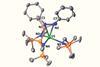
Four-electron transfer is a first for f-element chemistry
Uranium (II) systems shown to effect reduction of azobenzene to yield a bis(imido) uranium (VI) complex
-
 Research
Cadmium cyanide surprises chemists by shrinking when irradiated with x-rays
Contraction expands potential applications for inorganic materials
-
 Research
Organometallic manganese cluster resembles nesting dolls
Researchers make an intricate structure with a strong magnetocaloric effect
-
 Research
Double bond metathesis extended to germanium compounds
Partner swapping reaction carried out with digermene compounds, with no need for a catalyst
-
 Research
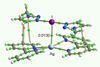
Cations pairs exhibit surprising attraction
‘Complex of complexes’ containing silver and iodonium ions experience an unprecendented interaction
-
 Research
Half the world’s supply of element 99 used to reveal its chemical secrets
Scientists explore einsteinium’s unusual chemistry using less than 200 nanograms of the precious and highly radioactive material
-
 Research
Holes cause sodium nitride to behave like a metal
Clathrate’s strange metallic nature caused by electronically active cavities
-
 Research
First flat tetravalent silicon stabilised by metals and aromaticity
Chemists make stable compound featuring a silicon atom that forgoes tetrahedral geometry
-
 Research
Beryllole is the first alkaline earth metal antiaromatic molecule
Metallacyclopentadiene is the first beryllium compound to engage in π system chemistry
-
 Research
Heavy-metal cluster sets size record for metal aromaticity
12 bismuth ring creates ‘substantial’ π aromaticity with only two aromatic electrons
-
 Research
258-atom endless knot created with thiazole ligands
Closed loop structure resembles Celtic and Buddhist symbols
-
 Podcast
Ionic liquids
Liquid salts, ionic melts, fused salts, or ionic glasses – call them what you like, these much-hyped solvents show great promise
-
 Research
New ordering of elements could help find materials with promising properties
Universal sequence of elements index uses atomic radii and electronegativity to make predictions about simple compounds
-
 Research
Trinuclear complex is a rare example of bottled double aromaticity
First report of a system containing a ruthenium atom that takes part in two different types of aromaticity simultaneously