


It’s Nobel season again! And we’re doing something a little different here on The chemical breakdown. Instead of our usual stories, in this episode we are turning the microphone to speculation and discussing who we think will be taking home the chemistry Nobel prize this year with Jamie Durrani and Neil Withers.
This week’s headlines
Featured stories
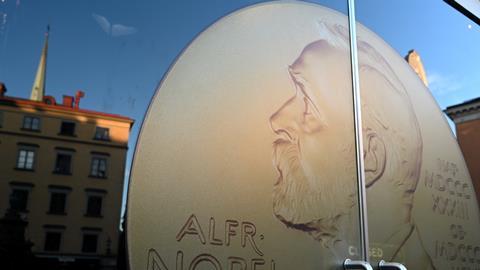
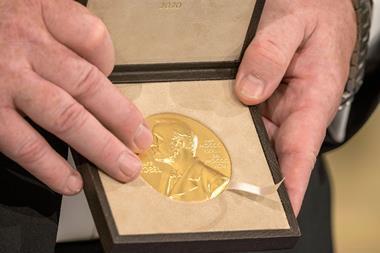
Each year the Nobel prize is awarded across six categories, including physiology/medicine, physics, literature, peace, economic sciences, and chemistry. This year the announcement of the chemistry prize is set for Wednesday 7 October.
Past winners have included last year’s metal organic frameworks, protein structure prediction and design, and quantum dots.
Who is slated to win the prize this year? We trace trends in previous award winners, current predictions being discussed including the Clarivate citation laureates, and chat through our own Chemistry World team’s predictions.
We would love to hear your feedback on this podcast, so if you have any questions or comments please get in touch.
Introduction and this week’s news
Mariana Kneppers
Welcome to this special Nobel prize-themed episode of The chemical breakdown. In honour of Nobel week next week, we’ll be discussing our picks for the chemistry prize this year, as well as unpicking previous winners and trends in the awards. Are there certain traits that make a Nobel prize winner? What’s it like to interview a Nobel laureate? And which names are floating around as potential winners this year?
I’m Mariana Kneppers, Chemistry World’s science media producer, and this is The chemical breakdown.
We’ll be diving deeper into all of this and more shortly, but first let’s take a look at this week’s news from the Chemistry World website.
A new lower temperature solventless method to depolymerise acrylic glass into monomers could offer an efficient, more environmentally friendly approach to recycle the material. The technique was developed by Swiss researchers who demonstrated it could produce high yields of pristine monomers ready for making new acrylic.
Spanish energy company Moeve started building a 300 MW solar-powered electrolyser this month to make CO2 emission-free green hydrogen in Huelva in the south of the country. Moeve intends to use the hydrogen to replace some of the fossil-derived hydrogen it uses at the existing refinery on site. as well as hydrogenating waste vegetable oils to make low-emissions liquid hydrocarbon fuels for aviation, shipping and heavy-duty rd transportation, and in chemical manufacturing.
A-team has found elemental sulfur in mammalian cells for the first time, suggesting there could be 10s of grams of S8 across a human body. They found that mammalian cells actively produce elemental sulfur, using it as an antioxidant to limit cell damage. While bacteria, plants and fungi are known to produce the material, this is the first time it has been detected in mammals.
And researchers based at the University of Ulm in Germany have developed a synthetic system that walks phosphate groups across the backbone of sugar-like compounds. It is the first example of a synthetic small molecule system that converts chemical fuel into directed motion without any intervention.
You can find these stories and more online. Just visit chemistryworld.com for more of the latest news in the chemical sciences.
Nobel season and the chemistry prize
It’s that time of year again, Nobel season, and we’re doing something a little different here on the podcast. Instead of our usual stories, today we are turning the microphone to speculation and discussing who we think will be taking home the chemistry prize this year.
For those of you that aren’t familiar with the Nobel prize, each year the Nobel prize is awarded across five categories, including physiology and medicine, physics, literature, peace, and most importantly, chemistry. This year, the announcement of the chemistry prize is set for Wednesday, October 7th. And past winners have included metal organic frameworks, which was last year, protein structure prediction and design, and quantum dots.
And we at Chemistry World will have a suite of dedicated content during the week. From a live blog the day of the announcement to loads of articles about the prize and this year’s winners, culminating in a live webinar on the Friday featuring a panel of experts closely involved with the research or people who worked with the winners, hopefully. So visit our website if you want to register.
And of course, there will be plenty of content in the lead up to the announcement as well, including this podcast.
So let’s jump right in here today to discuss all things Nobel. We have Chemistry World’s senior science correspondent Jamie Durrani and features editor Neil Withers. Hello to you both.
Jamie Durrani
Hey, Mariana.
Neil Withers
Hello.
Mariana Kneppers
Very exciting to be here. Thanks for joining.
What makes a Nobel prize winner?
So before we jump into any predictions, I wanted to kind of give a little bit of background on the Nobel prize and have a chat about what do we think makes a Nobel prize winner. Is there a concrete formula?
I mean, we have a really great Chemistry World article that you worked on, Neil, a couple of years back, along with some other members of the Chemistry World team. that took all of the data that’s available and really crunched the data behind it to see who’s won in the past, some of the trends in all of those winners.
So I wanted to kind of touch base on that. What patterns have you seen in the past in terms of, I don’t know, location, time? Yeah, what’s the fact you.
Neil Withers
We looked at an awful lot of different things of the backgrounds, where they’re from, where they work, where they publish their work, what sort of things their work is.
And sadly, one of the things that you can say straight away is they’re highly likely to be men. Very, very few women have won the chemistry Nobel prize, a few more in the last few years, which is good, since we did that analysis.
Jamie Durrani
I was actually just looking at the last 10 Nobel prizes in chemistry and across those 10 years, 24 men have won the Nobel prize in chemistry compared to just four women.
Neil Withers
And that four is probably more than there were in the 100 years before that. So sadly it is a very male dominated prize, which is of course one of the main criticisms that the Nobel prize gets among several others.
But I think the thing that I always, because we talk about this every year and it’s the big discussion among the team and when we’re at conferences we talk to people about it. And I think the thing to remember is that it’s generally not for work that’s been done in the last sort of five or 10 years.
It’s work that’s in the textbooks, that’s shown to work, if you like, and it maybe was done 20, 25, even 30 years ago, and that is absolutely rock solid. So the sort of the more trendy stuff that maybe that we’re reporting on at the moment or have been in the last few years is less likely to win.
Although, of course, as we were talking about the protein structure stuff, that was a much more recent one.
Mariana Kneppers
I was going to say, because that kind of exploded the past couple years with the advent of things like AlphaFold, which I think one of the creators was one of the winners of the prize that year.
Jamie Durrani
Two of the winners, yeah.
Mariana Kneppers
Two of the winners, yeah.
Neil Withers
Yeah, so that was a much more recent one. But then just a few years before that, the lithium-ion battery work, that was all done. That started in the 70s and in the 80s. Lithium batteries have been around in commercial devices since the early 90s. So that one had a much longer time scale.
How the timing of the Nobel prize has evolved
Mariana Kneppers
The actual Nobel prize itself, wasn’t the intention for the award to be awarded within 12 months? Is that what was in the…
Jamie Durrani
Yeah, so I think the Alfred Nobel’s original kind of wish was that the award would recognise the biggest discoveries from the last year, but that has evolved and changed quite a lot over sort of a century or so.
Neil Withers
I’m not sure it was ever even the case that they awarded it, because if you look at some of the very early ones, it feels like they were awarding things that was maybe in the preceding decades.
Jamie Durrani
We actually saw on the Chemistry World website there’s some really interesting videos that we recorded about 10 years ago with I think one of the former chairs of the chemistry committee for the Nobel prizes who gave a little bit of insight into some of the thinking behind some of the decisions.
And he kind of made the point that the committee wants to make sure that the research that they’re recognising has really had an impact, that will inevitably take a few years before they can really see like, was this the paradigm shifting piece of research? Or maybe things change, maybe things don’t quite live up to the initial expectations.
Mariana Kneppers
Yeah, that’s true. I think those interviews were with, I think his name is Bent Norton. Bent Norton, yeah. And yeah, those videos are quite interesting just because they do kind of peer behind the curtain a bit. A lot of it is still, there’s a lot of secrecy about the process, right?
But I did think that particular thing was quite interesting. And something that I think he also mentioned was who, also knowing who to nominate for the actual award, you know, something might have been discovered and that makes it quite obvious you can attribute it to a person. But if it’s a process and different people had different kind of levels of contribution over time.
The three-person limit and recognising research teams
Neil Withers
That’s of course the other thing that the Nobel Prize is heavily criticised for is that it can only go to three people a year. So in a lot of cases there have been people who’ve been… the 4th or 5th person on the list and they haven’t won because it can only go to three.
And again, it doesn’t recognise the fact that these individuals aren’t working in isolation. They’ve generally got very big research groups who are contributing over decades. So you think how many in a big academic group, they might have undergraduates, postgraduates, postdocs, staff scientists who will all work over a lot of time. And okay, they get some of the reflected glory. but not the actual prize.
Mariana Kneppers
I guess they can say on their CV, I worked in the Nobel prize-winning lab of insert name here. But yeah, it is a shame. I mean, I wonder if at some point they’ll be able to award it to entire teams, but you know, then who shows up to accept the award?
Neil Withers
They can’t change Nobel’s will. That’s the problem. It’s all done by that.
Other awards as indicators of future Nobel winners
Mariana Kneppers
The timing wise, we haven’t really followed the timing rules, have we? So I don’t know, it’s tough, isn’t it?
Are there any other kind of trends in terms of maybe prizes that people have won beforehand that might predict things? Like I know people talk about the Centenary Award or I’ve seen on Reddit people say like all these people have won the breakthrough prize, they’re probably going to be up next. Are there any kind of trends involving awards or specific awards that…
Neil Withers
Yeah, again, this is something that we looked at in detail a few years ago, trying to see if there was anything and because there’s the Wolf Prize, for instance, is a pretty good one as well. The Priestley Award, Centenary, and there are various Royal Society prizes that are pretty similar.
And I don’t know if we came to a really strong conclusion, but I think that what you can say is that the kind of people who are winning those other prizes are the kind of people who surely must be in the discussion and being nominated for the Nobel as well. So it’s worth a look.
Clarivate citation laureates and Nobel predictions
Mariana Kneppers
Speaking of which, Something that comes out every year are the Clarivate predictions, the citation laureates, I think is what they’re called. And every year people kind of discuss, well, sometimes those tend to dictate what winners come up in the Nobel prize. Not always right, of course, but Jamie, you recently wrote an article about this year’s Clarivate predictions. Do you mind giving us a bit of background of what this list is and how they decide these?
Jamie Durrani
Yeah, so like you say, every year Clarivate produces its list of potential Nobel prize winners, it refers to them as citation laureates. And the key metric that they look at is essentially the amount that this researcher has been cited by other researchers in their field.
And they say that, you know, if you’ve been cited thousands and thousands of times by other researchers in your field, then presumably your work has had a big impact and a big influence on that field. So typically citation laureates are in the top, I think, 0.2% of highly cited researchers.
I think Clarivate has been producing this list for over 20 years. I think 2002 was the first time they did it. And in that time they’ve named about 500 different citation laureates. Of those 500, 89 of them have gone on to win a Nobel prize.
Mariana Kneppers
I mean, that sounds like quite a good success rate, but.
Jamie Durrani
I mean, I think it’s an indicator that a researcher, has done work that is impactful. I think there’s probably lots of caveats you should put around that, different fields. people produce different numbers of papers.
And just because one paper is the most highly cited, does that mean it was the sort of very first sort of seminal piece of research in the field, which is what the Nobel committee are looking for? Perhaps, not always. But yeah, so to clarify, put this list together. It’s also worth mentioning that they sort of add to the list each year with new names.
Mariana Kneppers
It’s a continuous list.
Jamie Durrani
And so the 89 Nobel prize winners didn’t necessarily win the prize in the year that Clarivate identified them.
Mariana Kneppers
Oh, I see. Okay.
Jamie Durrani
So there’s often a bit of a lag. Although having said that, you mentioned the chemistry Nobel prize a couple of years ago that went to Demis Hassabis, John Jumper and David Baker for their work on protein folding. Clarivate had identified them in 2024 and then they won the prize just a few weeks later.
Neil Withers
I’m sure at the time that they predicted that, I must be on record somewhere saying, that’s ridiculous, that’s far too early. So it just goes to show, yeah.
Mariana Kneppers
That’s amazing, isn’t it? They definitely seem to be the outlier prize for sure.
Self-assembled monolayers
So this year they’ve identified 3 kind of main things that they’ve added to the list, right? So why don’t we run through some of these? So the first one was for the development of self-assembled monolayers. Do you mind giving us a bit of a background on that one, Jamie?
Jamie Durrani
Yeah, of course. So within the chemistry citation laureates, Clarivate sort of split them into three groups. So the first of these is the self-assembled monolayers, and they have noted David Allara, Ralph Nuzzo, and Jakob Sagiv. for their sort of groundbreaking work in this field.
So self-assembled monolayers are essentially like groups of molecules that can form ordered single molecule thick layers on a surface. And this has a whole bunch of different applications. They can be used in coatings, they can be used in catalysis, they have applications in electronics.
So really interesting area and this impact across a number of different sort of potential applications. That’s one of these things that we say the Nobel committee is kind of looking for, isn’t it? Like they want to see that some fundamental research has had wider implications.
Neil Withers
I think it’s quite interesting that sort of 20 years ago they predicted George Whiteside’s molecular self-assembly and that sort of thing. And he’s the sort of the first name that springs to mind with this sort of stuff. But I guess as they’ve already predicted him, they’re not adding him into this one as well.
Jamie Durrani
Yeah, I think that’s a really good point.
Neil Withers
Which it would be interesting for the, if the Nobel committee were to do this, would they pick the same names? Would they add white sides in or would they?
Jamie Durrani
Who’s going to miss out?
Mariana Kneppers
Oh, it must be so tough. I don’t know if it would make it easier if they released like a runners-up kind of list as well, but that almost might, that might be too depressing.
Jamie Durrani
Rub salt in the wounds.
Nobel nomination archives
Neil Withers
You’ve got to wait 50 years until they release the nominations. Do you actually? so you can see all the nominations. They’ve got an archive of the nominations and you can look back, but it’s only they’ve got a 50 year, what’s the word, embargo on it?
Self-assembled monolayers and the Nobel time lag
Jamie Durrani
I think something that’s probably worth noting with the self-assembled monolayers is that some of the real initial groundbreaking work in this area began in like the 1980s. So we were talking about the lag between when these kind of highly cited papers appear and when a Nobel prize might be awarded.
And so this one is like, if it went to this, there would have been like 40 odd years since the initial research to when it’s recognised with a Nobel Prize, should it win.
Mariana Kneppers
Yeah, so it’s had time to mature, so it kind of ticks that box.
Gene editing and David Liu
Jamie Durrani
Did you want me to talk you through some of the other? Yeah, So the other people on Clarivates. list for chemistry this year are Harvard University’s David Liu, who’s a very well-known researcher, who’s done a lot of work on kind of gene editing technologies.
So specifically Clarivate, we’re citing him for his work on base editing and prime editing, which are kind of very precise tools for editing genes, which obviously have applications in like medicine.
Mariana Kneppers
It sounds quite similar to what I think the Nobel prize was in 2020. Was it the chemistry one or the medicine one? But for Crispr.
Jamie Durrani
So that was the chemistry prize, yeah, in 2020.
Mariana Kneppers
That was, who was that again? It was Emmanuel and Jennifer Doudna, yeah. So do you think they would award a Nobel prize for something that is so similar if it’s already been just kind of the field of gene editing? I don’t know.
Jamie Durrani
You do get Nobel prizes awarded to research in sort of very closely related topics because those fields can evolve over time and new big discoveries can be made within them. Perhaps it would be unusual for it to go to a gene editing technology like just six years after. That might be a little bit close. But again, we don’t know exactly how the Nobel prize Committee.
Generations of Nobel-winning research
Neil Withers
If you think that Jean-Marie Lehn won it for sort of very early kind of, they weren’t molecular machines, then they were the kind of the crown ethers and krypton sort of super molecular stuff. And then one of his PhD students then won it with Fraser Stadart and co for the next step of that.
But that was several years apart. Jean-Pierre Savage, of course, that’s his name there, just escaped me for a second there. So that’s quite interesting that it’s 2 generations of sort of one set of work and then the next step of it. Yeah.
Mariana Kneppers
And you said it was his PhD student who won it the second time.
Neil Withers
Yeah, I think so. I think Sauvage worked for Jean-Marie Lane.
Mariana Kneppers
So some, yeah, generational kind of, yeah, award-winning there. That’s quite interesting.
Jamie Durrani
Is that not one of the predictors of if you will win a Nobel prize is did your supervisor win a Nobel prize?
Neil Withers
Absolutely, yeah.
Mariana Kneppers
But do you think that’s because they’ve just, because the Nobel prize brings so much resources, access, notoriety with it, does that bring with it funding opportunities for your students in your lab?
Neil Withers
I think it’s a very complicated question. I think it’s a lot of different factors. And I’m sure there’d be some cynical people who would have other views that it’s, you know, the rich get richer and the famous people get, you know, get rewarded with stuff.
But equally, if you’re in, or maybe if you’ve trained in that environment and you’ve learned that sort of highly innovative, pushing the boundary stuff. and you’re going to go on and do it.
Mariana Kneppers
I don’t know. Yeah, fair enough.
Long range electron transfer in proteins
Jamie Durrani
We should also mention Harry Gray and Jay Winkler, who were the remaining chemists on Clarivate’s list this year. They both work at the California Institute of Technology.
Mariana Kneppers
There’s a lot of Nobel prizes that come from Caltech, I think.
Jamie Durrani
But yeah, so Harry Gray, Jay Winkler, they’ve done some really groundbreaking work on understanding long range electron transfer in proteins. So this work has provided a lot of really important insights into the kind of biological function of proteins.
But also some of the understanding that’s come from that has applications in further removed areas than you might expect. So understanding these electron transfer processes can also help in the development of, there’s some drug therapies that have been developed on the basis of some of this understanding and also like energy production technologies as well, which are sort of understanding the movement of electrons across these different types of materials is incredibly. really important in that area too.
Mariana Kneppers
So across very differing fields, I mean, that’s pretty amazing.
Neil Withers
And going back to what we were saying before about sort of building on other prizes, that Rudy Marcus won the Nobel prize in 1992 for electron transfer stuff. So it’s kind of, again, it’s something that’s had one prize for one set of theory kind of stuff.
And then these guys have developed it even further. So it would be, it’s obviously a hugely important topic. I mean, chemistry is all about how electrons move and electron transfer. So it’s pretty fundamental for this stuff.
Clarivate predictions that cross into chemistry
Jamie Durrani
Sure. There’s also, I mean, I think it’s probably also worth mentioning just a few people who were identified by Clarivate in some of their other lists, because they also have citation laureates in physics and physiology and medicine to reflect the categories in the Nobel prizes.
And some of those researchers that were identified this year, like their work really heavily crosses over into chemistry as well. So one of them is Nicholas Balden, who’s a material scientist based in Switzerland. And she’s done really interesting work on magnetoelectric multiferroic materials, which have potential applications in really low power computing.
And also, yeah, in the medicine category, they identified some of the researchers whose work provided some of the basic understanding on which the new class of like GLP-1 drugs is based on.
Mariana Kneppers
I was thinking with all the chat about GLP-1s this past kind of year, two years, three years.
Jamie Durrani
But maybe that’s a hot tip for the Nobel Prizes medicine category.
Mariana Kneppers
Yeah, true. Or is it too soon?
Jamie Durrani
I don’t know. And maybe it’s too soon.
Neil Withers
Well, I mean, the drugs are out there. They’re selling in vast quantities, but they’re treating people. So I don’t think it’s…
Jamie Durrani
I think the evidence of the impact is there. Perhaps the difficult part would be who do you give the prize to? Because there’s the people doing the basic biology, there’s the people working on the actual drugs themselves.
The Chemistry World team’s Nobel predictions
Mariana Kneppers
There’s a lot of components in that. Yeah, that’s really true. Which brings me to want to discuss our own Chemistry World team prediction.
So we had a couple different people from the Chemistry World team submit their predictions to us because one of them actually did predict GLP-1s and we’ll play that voice note for you. I’d be interested to know if you guys can guess who out of the Chemistry World team would have predicted GLP-1s. Do you guys have any ideas?
Neil Withers
Philip, the business editor, as he’s…
Mariana Kneppers
No, actually no.
Jamie Durrani
Frankie. No. Frankie’s quite into her health and medicine stuff.
Mariana Kneppers
Yeah, she’s done quite a few stories on it, hasn’t she? But…
Neil Withers
Don’t know.
Mariana Kneppers
I’ll go ahead and play it for you guys.
GLP-1 drugs
Philip Robinson
I’m Philip Robinson and I’m the editor of Chemistry World. My pick for a Nobel this year would be a pretty easy one, I think, in that it’s definitely a Nobel prize-winning worthy work. And that’s for GLP-1 drugs, and specifically the anti-obesity drugs that have emerged from our understanding of GLP-1 and its effects in the body.
But it’s probably tricky to say who ought to get that prize, whether you award it for the understanding the fundamental work of understanding the biological mechanisms behind those drugs, in which case it’s probably a physiology or medicine prize, which is where this year’s Clarivate predictions have landed with those people.
Or whether you award it for work on developing the drugs based on our understanding of those mechanisms that have actually led to treatments for obesity and that have completely changed, transformed. society really in just a few short years, in which case that’s more of a chemistry achievement and you’d be looking possibly at some different people that should be recognised for that.
When that was awarded, when the Lasker Prize was awarded for GLP-1s a couple of years ago, I think there’s only one person in common between the Lasker Prize and this year’s Clarivate predictions for that kind of same GLP1 work.
So choosing who gets the prize will be the trickier part of it and perhaps for that reason it might not happen this year. The committee might decide to wait a little bit longer and hedge its bets a bit. But that would be my pick.
Mariana Kneppers
Exactly what we were talking about, right? Like could be too soon. Who do you choose for it? But no doubt a very big influential prize, whether it goes in medicine or chemistry, who knows, but wouldn’t be surprised to see it in my opinion. I’ll go ahead and play you guys another one.
Next generation DNA sequencing
Patrick Walter
My name is Patrick Walter and I’m the news editor at Chemistry World Magazine. My top tip for the chemistry Nobel Prize in 2026 is Shankar Balasubramanian and David Klenerman. And this is for their work on next generation DNA sequencing.
The work that they conducted at Cambridge University has enabled a genomics revolution. It’s now possible to sequence an entire human genome within days at a cost of under $1,000.
They’ve already won the Millennium Prize and the Breakthrough Prize in Life Sciences. These are really massive prizes that suggest that they could be tipped for future Nobel success. If they don’t win this year, I’m pretty sure they’re a shoe in for another year.
Mariana Kneppers
Is that something that you guys had thought of, that one?
Neil Withers
Yeah, it’s been on the list. It’s been it’s been talked about quite a lot.
Jamie Durrani
So it’s made the promise. bucket of potential Nobel prize winners. And that’s one that comes up year after year, isn’t it?
Neil Withers
I wouldn’t be surprised at all.
Other potential Nobel prize winners
Mariana Kneppers
Yeah. Are there any other ones that have those any other names that have been in the zeitgeist for quite a while that you can think of that maybe?
Neil Withers
Well, there have been loads. I think from a pure chemistry point of view, Buchwald and Hartwig for their eponymous cross-coupling reaction, that would be a real pure chemist’s one.
Jamie Durrani
Maybe some of the people in CH activation is an area that gets suggested year after year. And I think C-H activation is maybe another one where it’s tricky for the Nobel committee to decide which three people would you give it to.
Because there’s a lot of people who’ve done really interesting work in that area, but there’s, you know, some names that maybe come to mind are like Christina White, Jin Kwan Yu, Melanie Sanford. You could even go. all the way back and talk about like Robert Bergman as well, who did some of the very earliest work on CH activation, although over the years it’s kind of the applications and the way that people are sort of innovating, they’re looking at much more complex molecules, whereas Bob Bergman’s work was looking at sort of simple petrochemicals, I think.
Solar cells and whether a Nobel Prize can come too late
Neil Withers
I wonder with that whether that’s a, not that it’s It’s been around a little while, but whether it’s a little bit too soon, that sort of thing.
One thing that I’ve often been thinking recently is so people like Michael Gretzel has been developing these different sort of solar cells and Henry Snaith as well, the perovskite ones. But I wondered whether, because there’s now, you know, the solar panel production with silicon is now so cheap, they’re going to be everywhere, whether almost the sort of the previous generation of stuff that was developed before those guys is just going to come along and be everywhere.
And so having a slightly more efficient one or slightly cheaper, it’s just kind of missed the boat slightly. So I think that’s going to be interesting to see whether they’re discussing those kind of things, whether it’s too late.
Quantum dots and OLEDs
Jamie Durrani
From that point of view, you could kind of think back two, three years to when quantum dots won the Nobel prize and that was something that maybe felt a little bit out there for seasoned Nobel watchers like ourselves. It maybe wasn’t top of the list that we were predicting, but it was exactly that.
It was a technology that had massively scaled up. It’s used in all these high definition television screens and things and has had an enormous effect.
Neil Withers
On a similar note, I see that the physics citation laureates, they’ve suggested some people who I would consider chemists for a sort of an OLED prize, Mark Thompson, Steve Forrest, Chihaya Adachi, who were the, you know, I think Mark Thompson is definitely a chemist, the others are chemistry adjacent.
But that’s something that again, very similar to the quantum dots. OLEDs are in phones and TVs and et cetera. So that’s something that, again, it could be that.
Mariana Kneppers
Interesting one, isn’t it? So we’ve got two more voice notes. Let’s go ahead and listen to these ones and hear what. The rest of the team is predicting.
Skeletal editing
Mason Wakeley
Hi, I’m Mason Wakley, one of Chemistry World’s science correspondents. My prediction for this year’s Nobel Prize in Chemistry goes to Richard Sarpong, Mark Levin and Bill Mirandi for their work helping to establish the field of skeletal editing.
This field, while early in its days, is changing the way that chemists make molecules simply by swapping out one atom before another. I think this is a really cool technique and it’s meant that chemists can now make molecules that have been previously difficult to make.
Mariana Kneppers
Yeah, so skeletal editing or skeletal editing?
Jamie Durrani
I mean, it’s a topic that comes up in chemistry world all the time. the three researchers that Mason named just there are people who grace our pages. It feels like in every issue because they are doing really, really interesting work.
I mean, I would wonder again whether it’s a little bit early for skeletal editing because has it had the kind of big global impact that a lot of the topics that get Nobel prizes have already achieved, but it’s only when. I wonder whether it’s a little bit early.
Neil Withers
I think it feels quite early, but I think at the moment it’s lots of chemists are using these kind of things to make things in their lab. Is it being used industrially? Are like pharma companies using them on, you know, like megaton scales?
I’m not sure they are yet, but it’s the kind of thing that perhaps in 10 years when it’s all in the textbooks and we’ve forgotten about it, we’ll go, oh God, yeah, that was a, someone had to come up with those things. And that’s the kind of stuff that wins a Nobel prize.
Mariana Kneppers
All right, we’ve got one more and then we’ll move on to your guys’ prediction.
Synthetic gene circuits and synthetic biology
Emma Pusey
I’m Emma Pewsey, Chemistry World s comment and careers editor. It’s been a little while since we’ve had a chemistry Nobel that people have argued is really biology. So that’s what I’m going to go for this year.
I think it will be James Collins, Michael Elowitz, and Stanislas Leibler for their work on synthetic gene circuits, which arguably created the field of synthetic biology. In chemistry, synthetic gene circuits have opened up new methods of biocatalysis and new chemical sensors.
It’s maybe still an emerging technology industrially, but if it’s not already having a Nobel level impact on society, I think it will do soon.
Mariana Kneppers
Yeah, so Emma brings up a good point, is I see a lot of chat and I hear a lot of chat about people saying, you know.
Neil Withers
But is it chemistry?
Mariana Kneppers
It’s biology. Exactly that, like how the awards, not just chemistry, but other awards can kind of dip into other kinds of science, right? It’s like chemistry but biology or chemistry but physics or, physics but biology. And I think people are saying it’s been a while since we’ve had a biology chemistry award.
Neil Withers
I don’t know. Yeah, I think it does feel a little while. I mean, the protein structure and prediction, I think that’s sort of the what’s happening in the molecules, isn’t it? So we didn’t complain about that one too much. Bioorthogonal stuff, yeah. And the Crispr, I think we were all quite happy to claim that as chemistry.
So it has been a while since we’ve all whaled that it’s not chemistry. So So perhaps it’ll be this year again.
Mariana Kneppers
Time for a bit of complaining. What do you think, Jamie?
Where does chemistry end and biology begin?
Jamie Durrani
Yeah, I don’t know. I tend to find the complaining about whether a chemistry prize is actually chemistry. I just find it all a bit tedious, to be honest.
It is one of the big flaws of the Nobel Prizes, right, is that they’ve picked these sort of three main science categories, but so much science now, so much of the most exciting science is happening right on the interfaces of different subject areas that like… There’s no real biological.
I think as long as the prize goes to something that’s… really interesting and had a big impact, then who’s complaining really?
Mariana Kneppers
Yeah, that’s fair. You’re almost splitting hairs to a certain point. It’s, you know. And the nature of science increasingly is so interdisciplinary that, you know, it’s hard to put things into these categories. So, you know, is it worth our time to kind of complain about these things?
Jamie Durrani
Even when you get a chemistry prize that is, you know, pure chemistry, like maybe was it last year, MOFs won, and people couldn’t really argue about whether that was chemistry.
But one of the reasons they won is because of the applications they have in a whole bunch of different areas, like they’re used to sensors and gas storage and all these other things. Is that an engineering price?
Mariana Kneppers
Yeah, you could argue a couple different things.
Jamie and Neil’s Nobel predictions
So that brings us to our predictions, your predictions. Do you guys have any strong opinions either way? Or do you think somebody should win but might not win? You know, like that’s two different questions. Who will win and who should win? But I don’t know, Neil, what?
Neil Withers
Do you want to do? I spent a long time cheerleading for John Goodenough and he finally won. So I feel like I don’t need to be cheerleading too much nowadays.
But I think that one sort of category that often gets forgotten about a little bit in this chat is the sort of techniques, analytical, spectroscopic kind of things. And we haven’t had one of those since the cryo-EM one back in 2017.
So I wonder if there’s something out there that we’ve overlooked that we haven’t thought about too much that’s a sort of technique and allows people to make other discoveries, but you kind of forget that someone had to develop that in the 1st place. So that’s That’s something that I think could be up there.
I would love to see Harry Gray win. We talked about him earlier in the sort of electron transfer in protein stuff, but he’s, I wonder if he’s almost had too wide-ranging career.
You know, I know him as an inorganic chemist and he’s a, you know, incredibly wide-ranging stuff that he’s done, but he’s hugely influential in that he’s had an awful lot of people have gone through his group and then gone on to have their own groups and he’s really highly respected and he’s a really great guy as well. So go Harry.
Mariana Kneppers
Yeah, we’ll see. How about you, Jamie? What are you thinking?
RAS proteins and cancer medicines
Jamie Durrani
I don’t know that I have hugely strong feelings about it. I mean, I think as someone who writes about these prizes when they’re awarded, which can be quite a stressful period when all of the world’s media is descending upon two or three individuals and you want to try and get here a few minutes with them, I’d quite like it to be someone I know.
That you already have a connection. Someone that I’ve already interviewed before. Do you have their personal number? That would be really helpful. I mean, we talked about the CH activation people. There are people whose work I’ve covered fairly extensively in the past. So that would be really helpful if anyone in the Nobel Prize committee is listening in on our conversation.
I don’t know. I mean, there’s also some, I mean, there’s so much interesting research out there, isn’t there? One thing that kind of came to mind is we’ve had a few news stories recently in Chemistry World about new cancer medicines that target RAS proteins.
I saw on a Reddit thread about who might win the Nobel prizes that Kevan Shokat is a name that some people have mentioned in this area. So he did really important work on targeting RAS proteins, which are one of the most commonly mutated proteins in certain cancers.
And some of the newest drugs targeting some of the most difficult to target cancers have sort of built on that work and have received FDA approvals very recently. So I mean, that would be a really interesting, really exciting area that could win a prize. Maybe it would be a medicine prize. Maybe it’s a little bit too soon if the drugs have just got their approvals.
Mariana Kneppers
Yeah, I think we did that on the podcast last week, was one of the KRAS drugs. So yeah, it could be, it’s quite a recent development, isn’t it? Or at least recent in terms of now getting FDA approval and stuff, right?
Jamie Durrani
Sure, but yeah, you know, it’s one where like some of the initial discoveries about how to target these proteins were a few years ago. And obviously it takes a long time for those fundamental insights to translate into drugs that are then approved.
So, maybe that’s an area, but then we’re really just pulling it thin air. It could be absolutely anyone. I suppose the other thing that would be really fun is if if it goes to an area of chemistry that is just completely left field and not on anyone’s radar.
The appeal of an unexpected Nobel prize
Neil Withers
I think the one that always stands out for me is the quasi crystals one. When was that back in about 2009, 10? And everyone was talking about the different biology kind of things and the cross coupling kind of stuff.
And then they just came out with this thing that, and a lot of people didn’t even know anything about quasi crystals at all.
Mariana Kneppers
I’ve honestly never heard of it.
Neil Withers
Yeah, no, and so it was a real and it was a real shock and everyone was just. absolutely amazed. And then everyone found that, heard the story and it’s such a good story.
It’s like him against the world, no one believed that these things could exist and then he proved it and they changed the definition of a crystal based on this work. So something like that is just a great story would be brilliant.
Mariana Kneppers
Yeah, that’s fair. That does sound like a really good story.
Jamie Durrani
I do think like. I think that is one of the really positive things I would say about the Nobel prize. Again, as someone who writes about them every year, they always have super interesting stories behind them. The work behind the discoveries is always really, really interesting.
But yeah, maybe if it was something that’s not at the top of everyone’s tip list, that could be fun. It’d be nice to write about something that we haven’t already covered extensively in the magazine.
Outro
Mariana Kneppers
Yeah, oh God. Gosh, wow. Thanks so much, guys. I mean, looking forward to see how these predictions pan out next week. So thank you so much. Thank you.
That’s all for this edition of the podcast. If you’re interested and want to hear more about any of the items we’ve covered, check out chemistryworld.com for more of the latest stories in the chemical sciences.
You can also sign up for our weekly newsletters like Re:action, giving you a handpicked selection of stories from Chemistry World and beyond. from newsletter and research editor Jennifer Newton, or our industry brief containing essential analysis and insight on the industrial side of chemistry from business editor Phillip Broadwith.
I’m Mariana Kneppers. We’ll see you next time.
This transcript was generated by AI and checked by a human editor










No comments yet